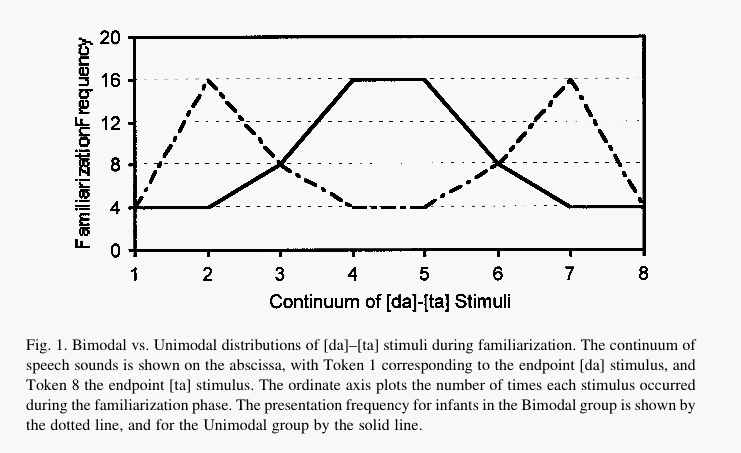
Distributional basis for within-organ categories
Hypothesis: For within-organ contrasts that are not associated with significant articulatory-acoustic nonlinearities, attunement to a bimodal distribution of exemplars in the environment affords the development of discrete categories.
Perceptual abilities of infants
(1-4 months)
Infants exhibit adult-like categorical
perception of speech stimuli
Evidence suggests that these organized behaviors
are part of the initial conditions of the infant:
- They are already organized at
birth
- They do not require specific
experience with speech.
Categorical Perception
Adults' abilities to discriminate
members of a stimulus continuum differing in a consonant-related
"cue" tend to be no better than their ability to categorize the
consonants:
Within category differences are poorly discriminated.
One-month old infants show the
same tendency
e.g., Voicing
Voicing contrast:
presence (/pa/) vs. absence (/ba/) of laryngeal spreading gesture
This difference causes systematic difference in
voice onset time (VOT)
Time between closure release and onset of
voicing
- /pa/ interval is long.
- /ba/ interval is short.
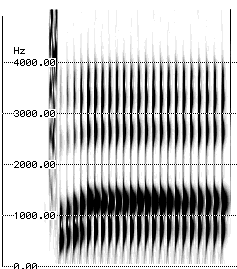
Possible to construct a VOT stimulus
continuum
|
|

|
|
VOT = 10 ms
|
VOT = 55 ms
|
Boundary for English-speaking adults is 30 ms
Eimas et al (1971) present three types of stimulus
changes to infants in HAS
technique:
- 0 ms-20ms (within-category voiced)
- 60ms-80ms (within-category voiceless)
- 20ms-40ms (across-category)
Sucking rate increases significantly (compared to
controls) when stimulus change is across adult categories, by not
when a change is within adult categories.
Acoustic change is the same in both cases (20
ms).
Almost every consonant category tested is
perceived categorically by young infants.
Experience vs. initial
conditions
Early experience appears not to be a
necessary condition for observing this organization to emerge.
Infants' performance does not depend on the
language spoken in the infants' environment.
Thus, results cannot be due to any learning infant
has accomplished by 1 month of age.
Kikuyu (Streeter, 1976)
has contrast between fully voiced and voiceless unaspirated stops (like some examples of "b,d,g" in English).
VOT of 20ms, 40ms are both in the same category
for adult speakers of Kikuyu.
Infants being raised in a Kikuyu-speaking
community (in Kenya) shows the same pattern of responses to these 20ms--40ms
differences as do infants raised in English-speaking
communities.
Within-organ constriction location contrasts
Infants can discriminate them when they are not contrastive in the adult's language, and when adults have difficulty discriminating them.
Nthlakampx
velar vs. uvular
Hindi
dental vs. retroflex
Development of sensitivity to gestural structure of the ambient language (7-12 mos.)
Decreased sensitivity to nonnative within-organ contrasts
At some point, infants keen ability to discriminate must decrease, given adults difficulties.
Experiments by Werker show that this decrease occurs during the first year of life.
Why do the behaviors of Hindi and English infants diverge at 10-12 months?
Presumably the phonologies of the languages have not yet been acquired by infants
Role of distributional information in percpetual discrimination (Maye et al, 2002)
Distribution of tokens in short (~100 item) familization session affects perceptual discriminability

This would provide a basis for the different behavior of e.g., Hindi and English-raised infants with respect to discrimination.
But is there evidence for bimodal distributions in the enviroment?
Distribution of Tongue Tip Horizontal Position in Coronal stops (in running speech)
|
Hindi
|
English
|
 |
 |
| Front <--------------------------------------------------->Back |
Front <--------------------------------------------------->Back |