
Vocal tract organs
Gestures of anatomically and functionally distinct constricting organs can serve to distinguish words:

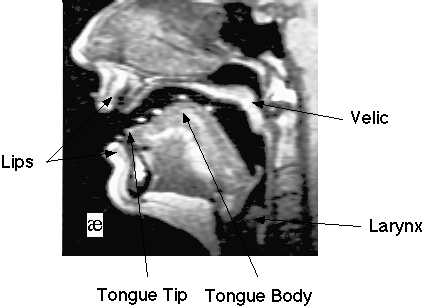
Gesture combinations and consonants
English words can begin with combinations of Oral, Laryngeal and Velic constriction gestures.
The resulting combinations are usually analyzed as consonants or consonant segments.
In the chemical analogy, segments are like ions, combinations of atoms that recur in many molecules (words):
e.g., "mad" begins with combination of
Velic Opening Laryngeal Narrowing Oral Labial Same combination of gestures occurs at the beginning of:
mode, meter, mackerel, mambo....
There are four logical combinations of Laryngeal and Velic gestures. One does not occur in English. Which one?
What would it sound like if it did?
Thus, from these gestures we can form 9 combinations in English.
|
Velic: |
|
|
|
|
Laryngeal: |
|
|
|
|
|
|
|
|
|
|
|
|
|
|
|
|
|
|
One consonant in English has a Laryngeal Opening gesture, but no Velic or Oral gesture. Which one?
This gives us 10 consonants (counting the one that is a Laryngeal gesture only).
English obviously has a great many more consonants than that. Where do the rest come from?
The number of possible consonants is increased in two possible ways:
