
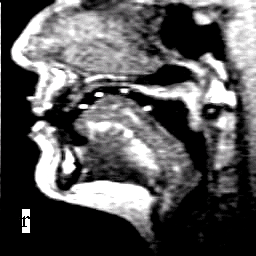
Multiple oral constrictions
"lie"
"rye"
|
|
|
|
|
|
Traditional description: "lie" is lateral, "rye" is central.
Relation of traditional five-term description of consonants (Ladefoged) to gestural analysis:
(1) Laryngeal gesture results:
voiced (<laryngeal narrowing)
voiceless (<laryngeal opening)(2) Location of oral constriction gesture
bilabial, labiodental
dental, alveolar, palato-alveolar
palatal, velar, uvular, pharyngeal(3) central or lateral
(4) Velic gesture results:
nasal (<velic opening)
oral (<velic closure)(5) Degree of oral constriction gesture
stop
fricative
approximant
Note that within the traditional five-term description, there is no explicit indication of the oral constriction organ (labial, coronal, dorsal), though it is implied by constriction locations. How?
e.g., consonant at the beginning of "bad"
Three gestures:
laryngeal narrowing
velic closure
Lips (CL: bilabial, CD: stop)Five-term description:
(1) voiced
(2) bilabial
(3) central
(4) oral
(5) stop
- How about consonant at the beginning of the word "sip"?
- The consonant at the beginning of the word "chip"?
- "lip" vs. "rip"?
In Ladefoged's descriptive system:
"lie" voiced alveolar lateral oral approximant
"rye" voiced alveolar central oral approximant
