Coordinative structures
(Bernstein, 1968; Greene,
1971; Turvey, 1972; Fowler, 1980;Kelso, Saltzman & Tuller,
1986)
Flexible pattern of cooperation among a set of articulators that serves to accomplish some functional goal.
Coordinative structures are an example of self-organization:
Cooperativity emerges from interactions among the component parts, rather than being imposed by an intelligent executive.
Evidence for coordinative structures in speech production
Multiple articulators and muscles cooperate in the achievement of vocal tract constriction goals.
e.g., Lip Closure:
- upper lip
- lower lip
- jaw
Evidence for coordinative structures:
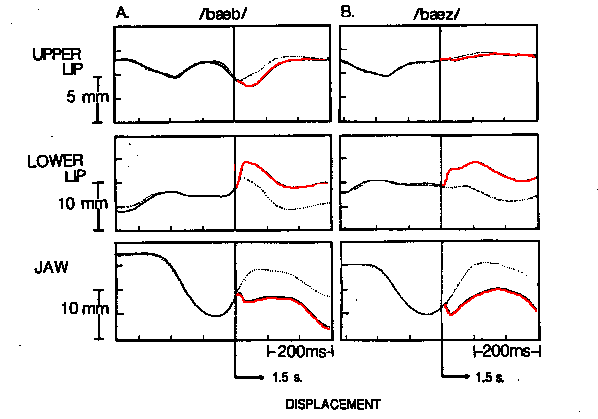
Compensation
When the task is threatened by a perturbation of one articulator (e.g., yanking on the speaker's jaw as (s)he is about to produce a lip closure), other articulators, remote from the site of the perturbation, act to to meet the challenge (e.g., increased displacement of upper lip).Speed
Compensatory action is extremely fast (20 ms or so). This implicates direct inter-articulator cooperation. There is not enough time for an executive to "manage" responses to perturbation.Task-specificity
Response to perturbation is task-specific, not hard-wired. If the subject is producing /z/, instead of /b/, response is not seen.
Levels of Task-dynamic description
Task level:
Articulator Level:
Context-dependence of gestures
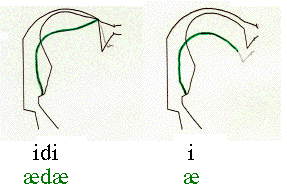
The use of different combination of articulators and muscles to produce the same constriction in different contexts can be modeled much like compensation phenomena.Note how the same TT gestures is produced in different contexts (in images below and in the movies here)
Invariant constriction task is correctly achieved. However, contributions of tongue tip, tongue body, jaw, articulators will automatically vary as a function of overlapping vowel gesture. The demands of the vowel gesture affect the Tongue Tip closure gesture just like an external perturbation.
Such context dependent differences are automatically generated by the task-dynamic model, as you can see here and in movies:
Thus, we can say that there is an invariant event associated with each gesture--not just in the mind of the talker/listener. The invariant is the dynamical system that gives rise to the observed articulatory motions.