Alphabetic symbols between square brackets
[...]
e.g.,
Annotation of details of the gestural score
Alphabetic symbols between square brackets [...]
e.g.,
Two transcriptions that differ in at least one symbol represent utterances that may or may not contrast
English:
in "ten times"
in "ten things"
Narrow transcription is much harder to learn than broad transcription.
What kind of details are represented?
(1) details of gestural overlap
aspiration of initial stops
nasalization of vowels before final nasals
(2) details of gestures' constriction degree and location
degree
Coronal stops and the laryngeal opening gestures "shrink" between stressed and unstressed vowels, and become approximants or "flaps"
e.g., "latest" [
]
location
Coronal stops are usually alveolar, but are dental before a dental fricative.
Variation in the narrow transcription of the same word
The same word can have different narrow transcriptions in different contexts.
"miss it"
vs."miss you"
Sentence recorded at two rates:
"I'm sure I'm going miss you."
slow
fast
Why does this change happen?
The gestural score for the word itself does not change, but when words are put together, they overlap at their edges.


The overlap of other gestures can cause the sound produced by a given gesture to change (if you listen very carefully).
The difficulty we have in perceiving this is probably due to the fact that we perceive the underlying contrastive gestural units, not their context-dependent consequences.
"ten times"
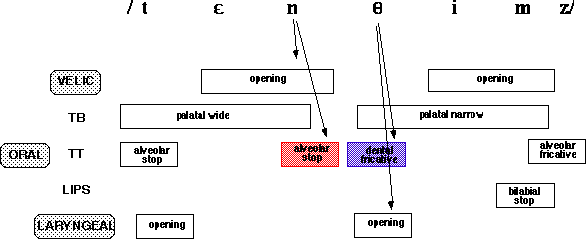
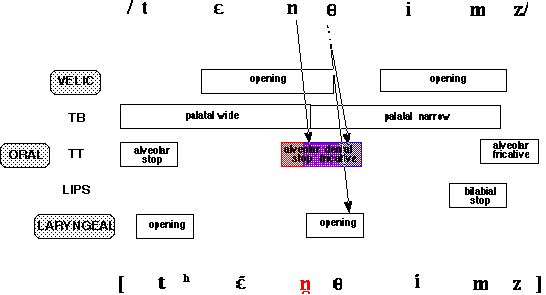
Overlap of two gestures that attempt to control the same constrictor causes blending of the two gestures.


