 (a) Start Segment
|

(b) Middle segment
|

(b) Ending segment
|
|
Figure 8: Distribution of majority perceived tone labels (among 3 annotators) across (a) start, (b) middle, and (c) ending segments
in MM-AU dataset.
|
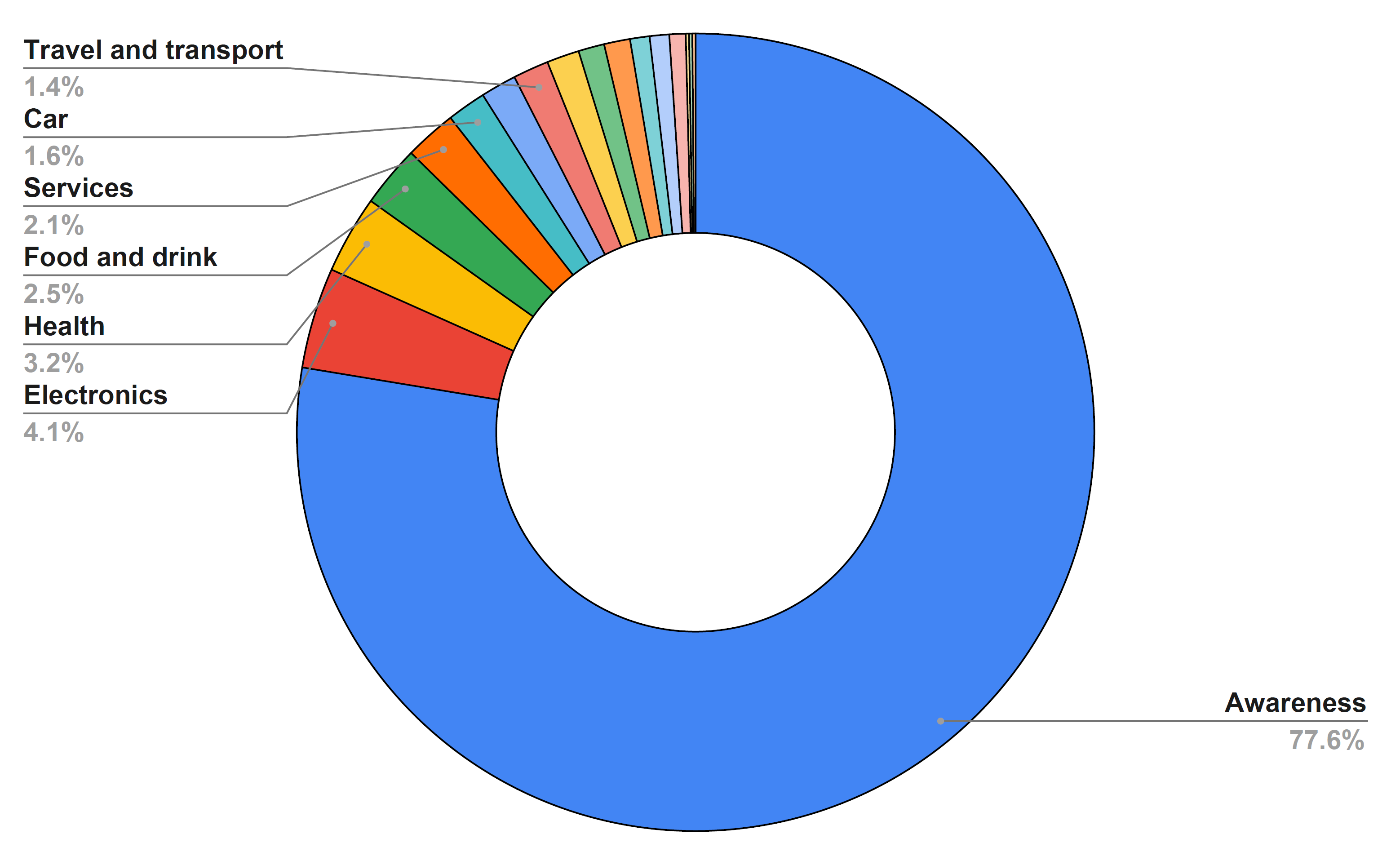 Figure 9: Distribution of topics wrt videos having social message (739 videos).
|

Figure 10: Distribution of tone transition wrt videos having social message (739 videos).
|
Multimodal fusion - Two stage approach
|
Figure 11: Outline of proposed two-stage multimodal fusion approach for audio-visual (AV) and text-visual (TV) transformers. Stage 1: Full
finetuning. Stage 2: Weights are completely frozen. The text, visual and audio encoders are kept completely frozen.
in MM-AU dataset.
|
- Stage 1: Train AV (AV-Tx) and TV (TV-Tx) transformers separately
- Stage 2: Freeze AV (AV-Tx) and TV (TV-Tx) transformers and use the following logit fusion strategies:
\begin{equation}\label{A-Max}
A_{max}: pred_{class}=argmax_{i}(TV_{logits}(i)+AV_{logits}(i))/2
\end{equation}
\begin{equation}\label{D-Max}
D_{max}: pred_{class}=argmax_{i}(\{ TV_{logits}(i),AV_{logits}(i) \})
\end{equation}
Experiments
Experimental setup
For training, validation, and testing purposes, we consider a split of 5877 (70%), 830 (10%), and 1692 (20%) videos.
The modality specfic setups are listed as follows:
|
Visual: Shot extraction using PySceneDetect [5] followed by frame wise feature extraction using CLIP [6]'s visual encoder (4 fps) and average pooling.
|
|
Audio: Use Audio Spectrogram Transformer [7] pretrained on AudioSet for extracting features at 10-sec intervals with the step-size of 512.
|
|
Text: Use multilingual Whisper [8] to extract transcripts and pretrained BERT [9] for text representations.
|
Language based reasoning
We explore zero-shot results based on application of language models for diverse tasks including topic categorization, social message and tone transition detection.
We report the results on 1670 non-empty transcripts. Task specific prompts for GPT-4 [10] are listed as follows:
Social message: An advertisement video has a social message if it provides awareness about any social issue.
Example of social issues: gender equality, drug abuse, police brutality, workplace harassment, domestic violence, child labor, environmental damage, homelessness, hate crimes, racial inequality etc.
Based on the given text transcript, determine if the advertisement has any social message. Please provide answers in Yes and No
Tone transition: Based on the given text transcript from the advertisement, determine if the advertisement has any transitions in tones.
Possible tone labels are: positive, negative, and neutral. Please respond by saying Transition and No transition
Topic categorization: Associate a single topic label with the transcript from the given set: <Topic list>
<Topic list> refers to the condensed list of 18 topic categories curated for MM-AU dataset.
|
Table 2: Zero shot performance comparison between various LLMs on MM-AU dataset.
Tasks: SM: Social message detection, TT: Tone transition, Topic: Topic categorization. $NA^{*}:$ Information not available. F1: Macro-F1. #social msg labels: total number of labels
|
GPT-4 performs better than other large-language models across all tasks. Further there is a trend towards increased model performance with scaling, except for Alpaca.
Unimodal vs Multimodal
|
Table 3: Comparative results between different unimodal and multimodal models across different tasks: Social message and Tone transition, Topic categorization. CLIP-S: Shot level features extracted using CLIP.
Modality: A: Audio, V: Visual, T: Text. Results are reported as an average of 5 runs with randomly selected seeds.
|
-
Text-visual fusion (TV) improves social message detection task as compared to unimodal.
-
Audio-visual (AV) fusion and A-Max logit fusion improves tone transition performance.
-
A-Max and D-Max logit fusion strategies improve topic categorization over AV and TV fusion (14 out of 18 categories)
References
-
[1] Ads of the world: https://www.adsoftheworld.com/
-
[2] Cannes Lion: https://www.canneslions.com/
-
[3] Automatic Understanding of Image and Video Advertisements: Z. Hussain, M.Zhang, X.Zhang, K. Ye, C. Thomas, Z. Agha, N. Ong, A. Kovashka; CVPR 2017
-
[4] Exploring Ads of the World: How Social Issues Are Framed in Global Advertisements: M. Brooks, C.Craig, S.Richard; Howard Journal of Communications 2020
-
[5] PySceneDetect: https://github.com/Breakthrough/PySceneDetect
-
[6] Learning Transferable Visual Models From Natural Language Supervision: A. Radford, J. Kim, C. Hallacy et. al
-
[7] AST: Audio Spectrogram Transformer: Y.Gong, Y.Chung, J. Glass
-
[8] Robust Speech Recognition via Large-Scale Weak Supervision: A.Radford, J.Kim, T. Xu et.al
-
[9] BERT: Pre-training of Deep Bidirectional Transformers for Language Understanding: J.Devlin, M.Chang, K. Lee, K.Toutanova et.al
-
[10]GPT-4: OpenAI


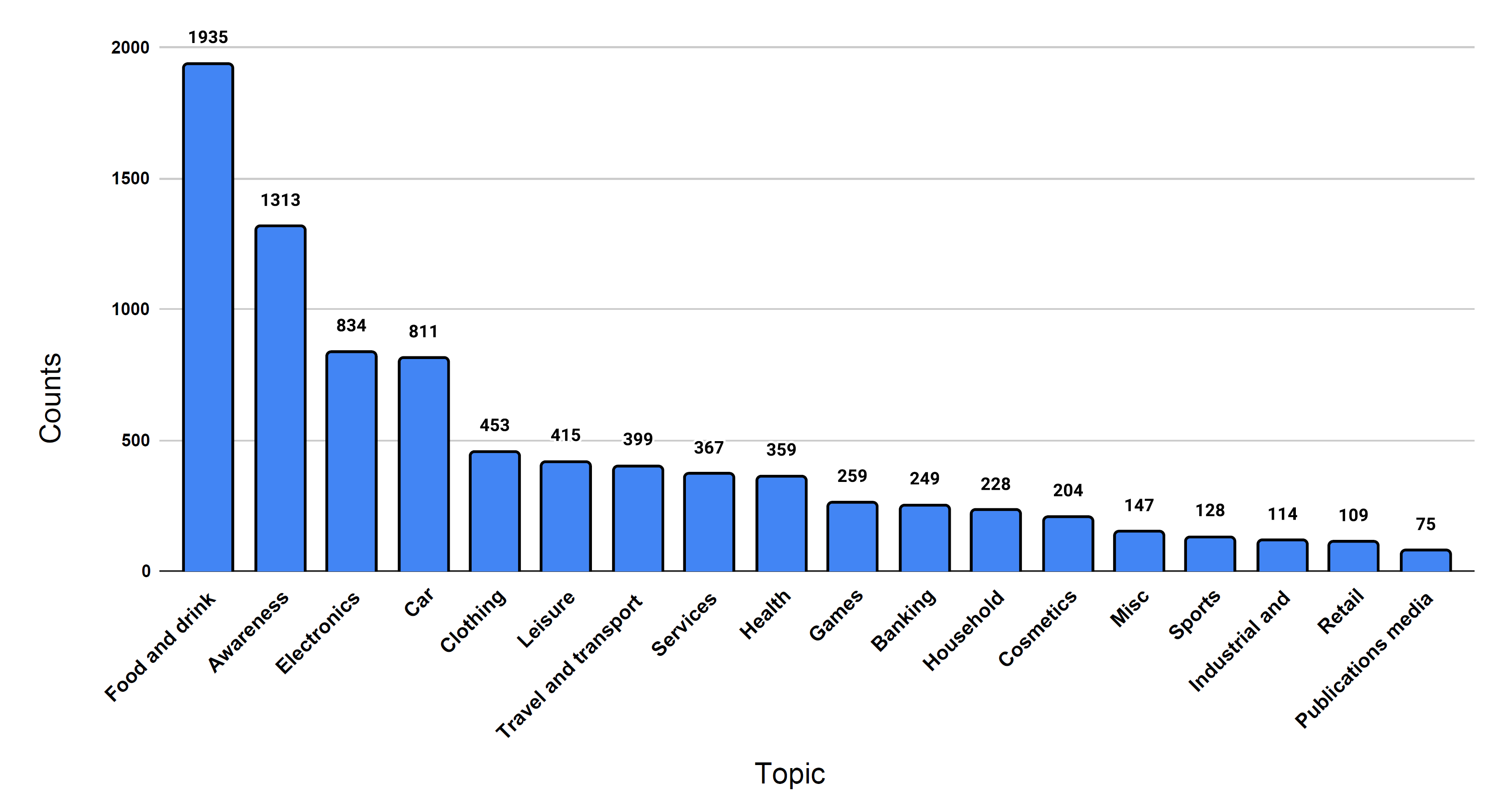
 Figure 6: Distribution of majority tone transition labels in MM-AU dataset.


